

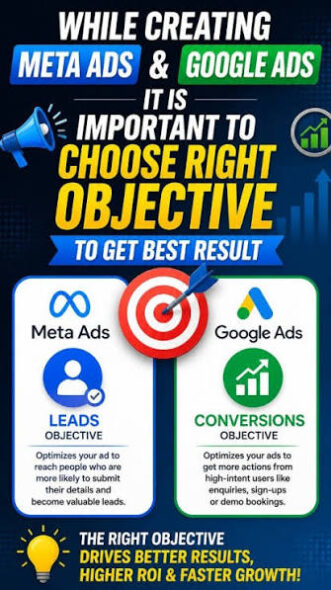
Every Meta advertising campaign starts with one decision: the objective. It looks like a simple dropdown, but it tells Meta’s delivery system what to optimize for and who to show your ads to. Choose well and the algorithm works for you. Choose poorly and you pay for results you never wanted.
Why the Objective Matters
Meta’s auction predicts which users are most likely to take the action you’ve chosen. If you pick Traffic, the system finds people likely to click links, including habitual clickers who rarely buy. If you pick Sales, it looks for people whose behavior resembles past purchasers. Same budget, same creative, very different outcomes.
The objective also determines which conversion events, placements, and optimization settings are available, so it shapes the whole campaign structure.
The Six Core Objectives
Meta simplified its objectives into six outcome-based options, each tied to a stage of the customer journey.
1. Awareness. This maximizes reach and brand recall. It suits product launches, new markets, and brand-building, where the goal is to be seen by as many relevant people as possible at low cost. The tradeoff is that it optimizes for exposure, not action, so don’t expect strong direct sales.
2. Traffic. This sends people to a destination such as a website, app, or messaging thread. It works for content promotion, blog growth, and top-of-funnel visits. The risk is low-quality clicks. Optimizing for landing page views rather than link clicks filters out people who tap and bounce before the page loads.
3. Engagement. This drives interactions: post reactions, comments, shares, video views, page follows, or messages. It’s useful for building social proof, growing an audience, and warming up prospects before retargeting. Engagement ads can also seed lookalike or retargeting audiences.
4. Leads. This collects contact information through instant forms, calls, or messaging. It fits service businesses, B2B, education, real estate, and any funnel where a sales team follows up. Lead quality matters more than volume here. Adding qualifying questions or higher-intent form settings reduces junk submissions.
5. App Promotion. This drives installs and in-app actions. It’s the natural choice for mobile apps, especially when you optimize for deeper events like registrations or purchases rather than installs alone.
6. Sales. This optimizes for purchases and other conversion events, such as add to cart or checkout starts. It’s the workhorse for e-commerce and any business with measurable revenue events. It depends on accurate tracking through the Meta Pixel and Conversions API.
Matching Objectives to the Funnel
A useful mental model is to treat the objectives as stages:
- Top of funnel: Awareness and Engagement build familiarity and audiences.
- Middle of funnel: Traffic and Leads capture interest and consideration.
- Bottom of funnel: Sales and App Promotion convert people who are ready to act.
Most mature accounts run campaigns at several stages at once, feeding warm audiences from the top into conversion campaigns below.
Common Mistakes to Avoid
Choosing a “cheaper” objective to get lower costs. Clicks and engagement are cheap because they’re easy to get. If your real goal is revenue, optimizing for a proxy usually costs more per sale in the end.
Ignoring data requirements. Sales campaigns need enough conversion events for the system to learn, and Meta generally looks for around 50 optimization events per ad set per week to exit the learning phase. Small accounts sometimes need to optimize for an earlier event, such as add to cart, before moving down to purchases.
Judging every campaign by the same metric. An Awareness campaign should be judged on reach, frequency, and cost per thousand impressions, not on ROAS. Mismatched success metrics lead to killing campaigns that were doing their job.
Neglecting measurement. Without a properly configured Pixel and Conversions API, the algorithm optimizes on incomplete data, and results suffer regardless of the objective.
A Simple Decision Framework
Ask one question: What is the single action that matters most to my business right now?
- If it’s being known, choose Awareness.
- If it’s visits, choose Traffic.
- If it’s conversation or community, choose Engagement.
- If it’s contact details, choose Leads.
- If it’s installs, choose App Promotion.
- If it’s revenue, choose Sales.
Then pick the deepest, most valuable conversion event you have enough data to support.
Conclusion
Meta’s objectives are a way of telling the platform what success looks like. The best-performing advertisers pick the objective that matches their real business goal, feed the system clean conversion data, and measure each campaign against the metric it was built to move. Get that alignment right and the rest of the work, from creative to targeting to budget, becomes much easier.
Meta occasionally renames or reshuffles options in Ads Manager, so check the current interface before building a campaign.